
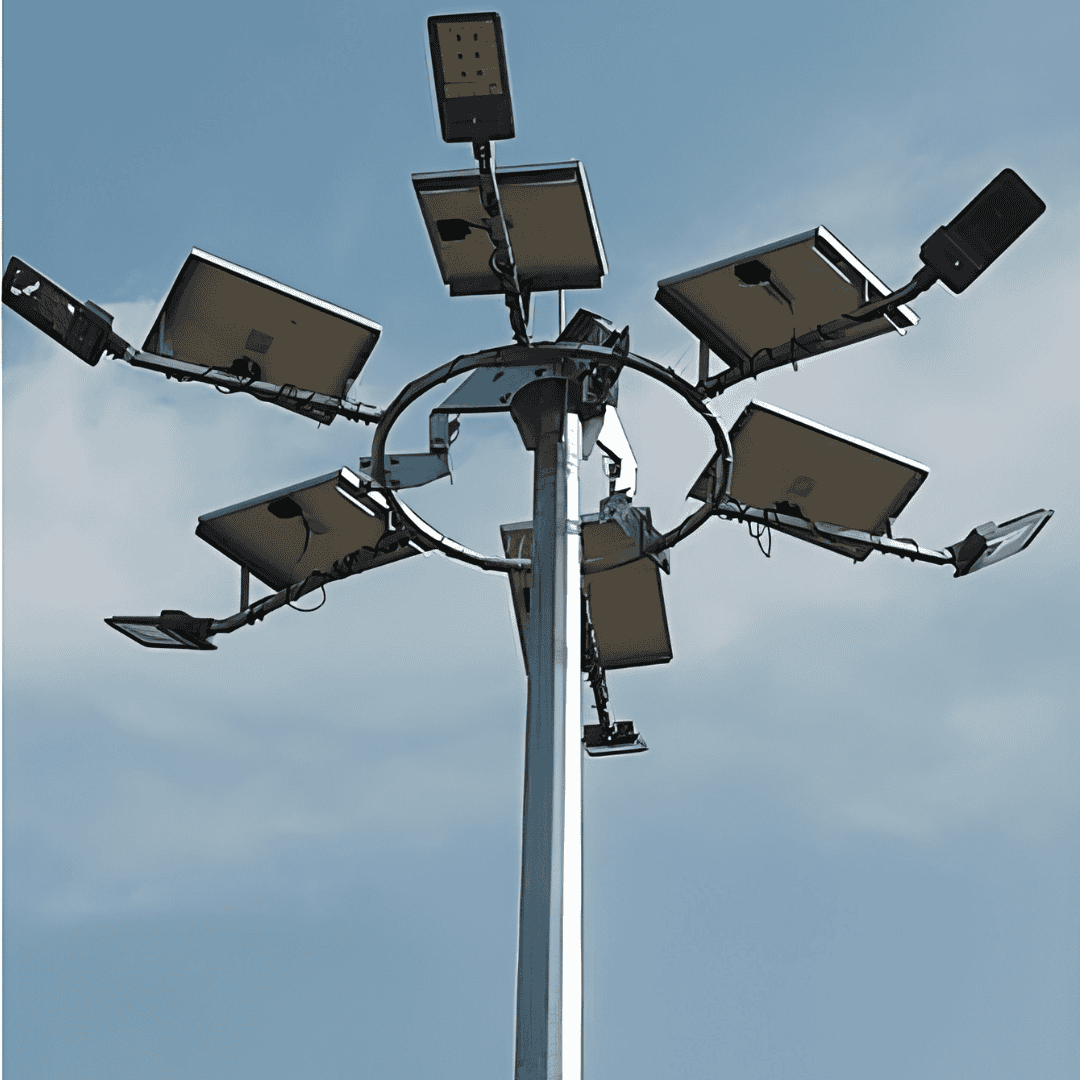
Illuminate large outdoor areas with reliable, energy-efficient and high-performance Solar High Mast Lighting Systems from S.S. Solar Energy (P) Ltd. – Energy Expert. Designed for highways, industrial areas, stadiums, parking areas, ports, airports, railway infrastructure, public spaces and other large-area applications, our solar high mast solutions combine high-intensity LED lighting with solar power and efficient energy storage.
As an experienced Solar High Mast Light Manufacturer in India, we provide solutions that can be customized according to project requirements, including pole height, LED wattage, number of luminaires, solar panel capacity, battery capacity and required lighting coverage.
Looking for a Solar High Mast Light for your project? Get in touch with our technical team for the right system configuration, project-specific design and quotation.
What Is a Solar High Mast Light?
A Solar High Mast Light is a high-mounted outdoor lighting system powered by solar energy and designed to illuminate large areas from an elevated pole. Unlike conventional high mast lighting systems that depend on grid electricity, a solar high mast uses solar panels to generate electricity during the day, a battery to store energy, and LED flood lights to provide illumination at night.
A complete Solar High Mast Lighting System generally consists of a high mast pole, LED flood lights, solar panels, lithium battery, solar charge controller, mounting structures, cables and other electrical and mechanical accessories. The system can be engineered according to the required lighting area, pole height, illumination level, operating hours and site conditions.
Solar high mast lighting is particularly useful where large areas need powerful and uniform illumination or where connecting a conventional lighting system to the electrical grid is difficult or expensive.
At S.S. Solar Energy (P) Ltd. – Energy Expert, we provide solar-powered high mast lighting solutions for infrastructure, industrial, commercial, institutional and government applications with project-specific configurations.
How Does a Solar High Mast Lighting System Work?
A Solar High Mast Lighting System works by converting sunlight into electrical energy, storing that energy in a battery and using it to power high-intensity LED lights after sunset. The complete system is designed to operate automatically, providing reliable illumination without depending continuously on grid electricity.
How a Solar High Mast Works
1. Solar Energy Generation
During the daytime, solar panels installed on the high mast system absorb sunlight and convert it into electrical energy.
2. Battery Charging
The electricity generated by the solar panels is regulated through a solar charge controller and stored in a high-capacity battery. Lithium battery technology can be used for efficient energy storage and reliable night-time operation.
3. Automatic Lighting at Night
When sunlight decreases and evening begins, the controller activates the LED flood lights automatically. A dusk-to-dawn control system can be used to switch the lights on and off according to ambient light conditions.
4. High-Intensity LED Illumination
Multiple LED flood lights mounted at the top of the Solar High Mast Pole distribute light over a large area. The number, wattage and beam angle of the lights can be selected according to the site’s lighting requirements.
5. Energy Management
The controller manages solar charging, battery protection and power delivery to the LED lights. Properly designed systems can also incorporate features such as programmable lighting schedules, battery protection and optional remote monitoring.
Solar High Mast Working Principle
The basic working principle can be summarized as:
Sunlight → Solar Panel → Solar Charge Controller → Battery Storage → LED Flood Lights → Large-Area Illumination
Because the system generates and stores its own energy, solar high mast lighting can be particularly suitable for highways, industrial areas, stadiums, parking areas, ports, airports, railway infrastructure, public spaces and locations where grid connectivity is limited.
The actual performance of a solar high mast depends on factors such as solar radiation, panel capacity, battery capacity, LED load, required operating hours, weather conditions, pole height and site-specific lighting requirements. Therefore, the system should be properly sized according to the project rather than using a one-size-fits-all configuration.
Solar High Mast System Components
A complete Solar High Mast Lighting System consists of several mechanical, electrical and solar components that work together to provide efficient large-area illumination. The exact configuration can be customized according to pole height, lighting requirements, geographical location, operating hours and project specifications.
1. Solar High Mast Pole
The Solar High Mast Pole is the primary structural component that supports the lighting assembly and other system components. The pole height and design are selected according to the required lighting coverage, site conditions, wind load and project requirements.
High mast poles can be engineered in different heights and configurations for applications ranging from large parking areas and industrial premises to highways, stadiums and infrastructure projects.
2. LED Flood Lights
High-intensity LED Flood Lights are installed at the top of the mast to illuminate a wide area. LED technology provides efficient illumination with comparatively low energy consumption and a long operating life.
The number and wattage of LED flood lights can be selected according to the required illumination level, mounting height and area to be covered.
3. Solar Panels
Solar panels generate electricity by converting sunlight into electrical energy. The required solar panel capacity depends on the LED load, battery capacity, location, solar radiation and expected operating hours.
Proper solar panel sizing is essential to ensure adequate battery charging and reliable night-time operation.
4. Lithium Battery
The battery stores the electricity generated by the solar panels during the day and supplies power to the LED lights at night.
Modern lithium battery technology can offer advantages such as high energy density, efficient charging, long cycle life and comparatively lower maintenance requirements. Battery capacity should be selected according to the lighting load, backup requirement and local environmental conditions.
5. Solar Charge Controller
The Solar Charge Controller regulates the flow of electricity between the solar panels, battery and lighting load. An MPPT-based controller can be used where higher charging efficiency and better solar energy utilization are required.
The controller can also provide functions such as battery protection, charging management, load control and system monitoring, depending on the selected configuration.
6. Lighting Ring / Luminaire Mounting Structure
A lighting ring or mounting structure is installed at the top of the high mast pole to securely hold multiple LED flood lights. Its design determines the positioning and orientation of the luminaires and helps achieve the required lighting distribution.
The mounting arrangement can be customized according to the number of lights and project-specific illumination requirements.
7. Solar Panel Mounting Structure
A strong mounting structure is used to securely position the solar panels at the required orientation and inclination. Proper positioning helps maximize exposure to sunlight and supports efficient solar energy generation.
The mounting structure should be designed according to the site location, wind conditions and selected solar panel configuration.
8. Foundation and Anchor Bolts
The high mast foundation provides structural stability to the pole. The foundation design depends on factors such as pole height, soil conditions, wind load, pole weight and site requirements.
Heavy-duty anchor bolts and an appropriate foundation arrangement help secure the mast to the ground.
9. Cables, Connectors and Electrical Protection
Cables, connectors, junction boxes and electrical protection devices connect the solar panels, controller, battery and LED lighting system.
Properly selected electrical components help improve system safety, reliability and long-term performance.
10. Automatic Lighting Control
A solar high mast can use automatic control technology to switch the lighting system on and off according to ambient light conditions. Advanced configurations may also support programmable operating schedules, dimming and remote monitoring.
Complete Solar High Mast System
The complete system can therefore be understood as:
Solar Panel + Solar Charge Controller + Battery + LED Flood Lights + High Mast Pole + Mounting Structure + Foundation + Electrical Accessories
The exact components and specifications should always be selected according to the project’s lighting requirements, location, operating conditions and required backup.
Solar High Mast Light Specifications
The specifications of a Solar High Mast Lighting System depend on the required illumination area, pole height, LED load, operating hours, solar radiation, battery backup and project conditions. At S.S. Solar Energy (P) Ltd. – Energy Expert, solar high mast systems can be configured according to specific application and project requirements.
| Specification | Available / Customizable Options |
|---|---|
| Product Type | Solar High Mast Lighting System |
| Pole Height | 6 m, 7 m, 9 m, 10 m, 12 m, 15 m, 18 m and higher, as required |
| Lighting Source | High-Efficiency LED Flood Lights |
| LED Configuration | Single or Multiple LED Flood Lights |
| LED Wattage | Project-specific |
| Solar Panel | Mono / high-efficiency solar modules as required |
| Battery | Lithium battery / project-specific configuration |
| Battery Capacity | Based on load and required backup |
| Solar Charge Controller | PWM / MPPT, according to system design |
| Lighting Control | Automatic dusk-to-dawn / programmable control |
| Pole Material | High-strength steel, as per design |
| Pole Finish | Protective coating / galvanization as specified |
| Mounting | Multi-light high mast mounting arrangement |
| Lighting Coverage | Designed according to pole height, optics and site requirements |
| Operating Hours | Based on solar generation, battery capacity and system load |
| Protection | Suitable electrical and environmental protection |
| Installation | Site-specific foundation and installation |
| Monitoring | Optional smart / remote monitoring |
| Customization | Available according to project requirements |
Solar High Mast Pole Height and Lighting Capacity
The pole height, LED wattage and number of flood lights are selected together to achieve the required illumination and coverage. A higher pole does not automatically mean better lighting; the complete lighting design should consider mounting height, beam angle, luminaire output, spacing and the area’s required illumination level.
Solar Panel and Battery Sizing
Solar panel and battery capacity should be calculated according to the total LED load and desired operating hours. Local solar conditions, seasonal variation, required backup and system efficiency should also be considered while designing the system.
Customized Solar High Mast Specifications
For large infrastructure and commercial projects, the Solar High Mast Light specifications can be customized according to site conditions and technical requirements. This allows the system to be designed for applications such as highways, stadiums, industrial areas, large parking facilities, airports, ports, railway infrastructure and other large outdoor spaces.
For an accurate configuration, the required pole height, lighting area, operating hours and project location should be evaluated before finalizing the Solar High Mast Lighting System.
Solar High Mast Pole Heights
The Solar High Mast Pole height plays an important role in determining the lighting coverage, light distribution and overall performance of a high mast lighting system. The appropriate height depends on the size and shape of the area, required illumination level, number of LED flood lights, mounting arrangement, site conditions and project requirements.
Solar high mast poles can be designed in different heights to suit applications ranging from large parking areas and industrial premises to highways, stadiums and major infrastructure projects.
Common Solar High Mast Pole Heights
- 6 Meter Solar High Mast – Suitable for smaller large-area applications and selected commercial or institutional premises.
- 7 Meter Solar High Mast – Used where moderate mounting height and area coverage are required.
- 9 Meter Solar High Mast – Suitable for parking areas, industrial premises and medium-sized outdoor spaces.
- 10 Meter Solar High Mast – Useful for applications requiring increased mounting height and wider illumination.
- 12 Meter Solar High Mast – Commonly considered for larger industrial, commercial and infrastructure areas.
- 15 Meter Solar High Mast – Suitable for highways, large parking areas, industrial facilities and other extensive outdoor spaces.
- 18 Meter Solar High Mast – Designed for applications requiring higher mounting and broad-area illumination.
- 20 Meter Solar High Mast – Suitable for large infrastructure and high-area lighting requirements.
- 25 Meter Solar High Mast – Used for very large outdoor areas where higher mounting and wide light distribution are required.
- 30 Meter Solar High Mast – Suitable for major infrastructure, large yards and other extensive illumination applications.
How to Choose the Right High Mast Height?
Choosing a Solar High Mast Pole should not be based on height alone. The complete lighting design should consider:
- Area to be illuminated
- Required illumination level
- LED flood light wattage
- Number of LED luminaires
- Beam angle and optical distribution
- Distance between individual masts
- Pole location and mounting arrangement
- Wind load and structural requirements
- Solar panel and battery configuration
- Site-specific conditions
For example, a large highway, stadium or industrial yard may require a different high mast configuration than a parking area of similar dimensions because the required light distribution and illumination levels can differ.
Customized Solar High Mast Pole
At S.S. Solar Energy (P) Ltd. – Energy Expert, high mast lighting solutions can be configured according to project requirements. Pole height, LED configuration, solar panel capacity, battery capacity and lighting arrangement can be selected based on the site’s technical requirements.
For the right Solar High Mast height and lighting configuration, a proper site assessment and lighting design are recommended before installation.
Features and Benefits of Solar High Mast Lighting
A Solar High Mast Lighting System combines solar energy generation, energy storage and high-intensity LED lighting to provide powerful illumination for large outdoor areas. Its configuration can be customized according to the application, lighting requirement and site conditions.
Key Features of Solar High Mast Lights
1. Solar-Powered Operation
The system generates electricity from sunlight, stores it in a battery and uses the stored energy to operate the LED lights at night.
2. High-Intensity LED Lighting
High-efficiency LED flood lights provide powerful illumination and can be configured according to the required lighting level and coverage area.
3. Large-Area Illumination
Multiple luminaires mounted at an elevated height can distribute light across large outdoor spaces, reducing the need for numerous individual lighting poles in suitable applications.
4. Multiple Pole Height Options
Solar high mast poles can be designed in different heights according to the area, lighting layout and project requirements.
5. Automatic Night-Time Operation
Automatic lighting controls can switch the lights on after sunset and off during daylight, reducing the need for manual operation.
6. Lithium Battery Energy Storage
Lithium battery configurations can provide efficient energy storage and reliable power delivery for night-time lighting.
7. MPPT Solar Charging
MPPT-based solar charge controllers can be incorporated where higher solar charging efficiency and optimized energy harvesting are required.
8. Customizable Lighting Configuration
The number, wattage, optics and positioning of LED flood lights can be selected according to the required illumination and site layout.
9. Optional Smart Monitoring
Advanced systems can be configured with remote monitoring and control features for tracking system performance and operating status.
Benefits of Solar High Mast Lighting
Reduced Dependence on Grid Electricity
Since the system generates and stores its own solar energy, it can reduce dependence on conventional grid electricity for outdoor lighting applications.
Lower Operating Costs
Solar energy is available without ongoing electricity consumption from the grid. Combined with efficient LED lighting, this can help reduce the long-term operating cost of suitable lighting projects.
Suitable for Remote Locations
Solar high mast lights can be particularly useful in locations where grid connectivity is unavailable, difficult to establish or expensive to extend.
Wide Lighting Coverage
Elevated mounting and multiple LED flood lights can provide broad illumination for highways, industrial areas, stadiums, parking areas, ports, airports and other large outdoor spaces.
Low Maintenance Requirements
LED lighting and properly designed solar systems can reduce routine maintenance requirements. Periodic inspection of solar panels, batteries, electrical connections, LED luminaires and structural components is still recommended.
Environmentally Friendly Lighting
Solar energy is a renewable source of power. Using solar energy for outdoor lighting can help reduce dependence on electricity generated from conventional fossil-fuel sources.
Flexible Project Design
A Solar High Mast Lighting System can be designed around the project’s specific requirements, including pole height, LED load, solar panel capacity, battery capacity, lighting hours and coverage area.
Reliable Automatic Lighting
With appropriate battery sizing and system design, solar high mast lighting can provide automatic night-time illumination without requiring manual switching every day.
Why Choose a Solar High Mast?
A solar high mast is a practical option when a project requires powerful lighting over a large outdoor area while reducing dependence on grid electricity. The best configuration depends on the site’s lighting requirements, solar conditions, operating hours, structural requirements and project budget.
Energy Expert by S.S. Solar Energy (P) Ltd. provides customizable solar lighting solutions designed around individual project requirements, making solar high mast lighting suitable for infrastructure, industrial, commercial, institutional and government applications.
Solar High Mast Light Applications
Solar High Mast Lights are designed to provide powerful and wide-area illumination from an elevated mounting height. Their combination of solar power, battery storage and multiple LED flood lights makes them suitable for a wide range of outdoor, infrastructure, industrial and commercial applications.
The system can be customized according to the area’s size, required illumination, pole height, LED configuration, operating hours and site conditions.
1. Highways and Expressways
Solar High Mast Lighting can be used along highways and expressways to illuminate large sections, intersections, service areas, entry and exit points and other critical locations where reliable outdoor lighting is required.
2. Toll Plazas
Solar high mast lights can provide broad illumination across toll plazas, approach roads, vehicle lanes and surrounding areas, helping maintain visibility during night-time operations.
3. Stadiums and Sports Grounds
Large sports facilities require wide and uniform outdoor illumination. Solar High Mast Lights for stadiums and sports grounds can be configured with multiple LED flood lights to cover open areas, entrances, parking zones and surrounding facilities.
4. Industrial Areas and Factories
Industrial facilities, manufacturing plants and factory premises often require lighting across large outdoor areas. Solar high mast systems can be used for internal roads, loading zones, open yards, production-area surroundings and security-sensitive locations.
5. Large Parking Areas
Solar High Mast Lights for parking areas can provide wide-area illumination while reducing the need for multiple conventional lighting points in suitable layouts.
They can be used in:
- Commercial parking lots
- Industrial parking areas
- Bus parking facilities
- Truck parking areas
- Mall and institutional parking
- Large public parking spaces
6. Warehouses and Logistics Parks
Large warehouses, distribution centres and logistics parks often have extensive outdoor yards and vehicle movement areas. Solar high mast lighting can illuminate loading zones, access roads, parking areas and open storage spaces.
7. Ports and Container Yards
Ports and container terminals require high-level illumination over large operational areas. Solar high mast systems can be considered for container yards, access roads, parking areas and other outdoor sections where suitable solar conditions and lighting design are available.
8. Airports
Solar high mast lighting can be used for selected airport outdoor areas such as parking facilities, access roads, service zones and perimeter-related infrastructure, subject to applicable aviation and site-specific requirements.
9. Railway Stations and Railway Infrastructure
Solar high mast lights can provide illumination for selected railway infrastructure areas including station surroundings, parking spaces, yards, access roads and other outdoor locations where high-area lighting is required.
10. Public Parks and Open Spaces
Large parks, recreational areas, public grounds and community spaces can use solar high mast lighting to improve visibility across open areas while using renewable solar energy.
11. Construction Sites
Temporary or semi-permanent construction sites may require lighting for large work zones, material storage areas, access roads and equipment movement areas. Solar high mast systems can be considered where grid connectivity is limited.
12. Government and Municipal Projects
Solar High Mast Lighting Systems are suitable for various government and municipal infrastructure projects where large-area outdoor illumination and energy-efficient lighting are required.
Applications may include:
- Public grounds
- Municipal facilities
- Government campuses
- Rural infrastructure
- Community areas
- Roads and public spaces
- Large government premises
13. Rural and Remote Areas
Solar high mast lights can be particularly useful in remote locations where extending grid electricity infrastructure may be challenging or uneconomical.
14. Exhibition and Event Grounds
Large exhibition grounds, fairgrounds, event spaces and temporary public gathering areas can require broad outdoor illumination. Solar high mast systems can be designed according to the event layout and lighting requirement.
15. Security and Perimeter Areas
Large industrial, infrastructure and institutional premises may require lighting around perimeter roads, open yards and security-sensitive areas. Properly positioned high mast lights can improve nighttime visibility across these spaces.
Why Use Solar High Mast Lighting for Large Areas?
For large outdoor spaces, a properly designed Solar High Mast Lighting System can provide high-level illumination while utilizing renewable solar energy. The final number of masts, pole height, LED wattage, lighting distribution, solar panel capacity and battery size should be determined through a site-specific lighting and energy assessment.
Energy Expert by S.S. Solar Energy (P) Ltd. provides customizable solar lighting solutions for infrastructure, industrial, commercial, institutional and large-area applications across India.
Industries We Serve with Solar High Mast Lighting
A Solar High Mast Lighting System can be designed for industries and infrastructure projects that require powerful, reliable and wide-area outdoor illumination. The appropriate pole height, LED configuration, solar panel capacity and battery storage are selected according to the application’s lighting requirements and site conditions.
Government & Municipal Infrastructure
Solar high mast lights can be used in government facilities, municipal projects, public grounds, rural infrastructure and other large public areas where energy-efficient outdoor lighting is required.
Highway & Infrastructure Projects
Highways, expressways, toll plazas, intersections, service areas and other transportation infrastructure can benefit from high-area illumination provided by appropriately designed solar high mast systems.
Manufacturing & Industrial Facilities
Factories and manufacturing units often have large outdoor spaces requiring continuous night-time visibility. Solar high mast lighting can be used for internal roads, open yards, loading areas, parking facilities and facility surroundings.
Logistics & Warehousing
Warehouses, logistics parks, distribution centres and freight facilities can use solar high mast lights for vehicle movement areas, loading and unloading zones, truck parking, storage yards and access roads.
Sports & Stadium Facilities
Stadiums, sports complexes, athletic grounds and large recreational facilities can use multiple high-intensity LED luminaires mounted on high mast poles for broad outdoor illumination.
Airports & Aviation Infrastructure
Selected airport parking areas, access roads, service zones and other outdoor infrastructure can be considered for solar high mast lighting, subject to site-specific technical and aviation requirements.
Ports & Maritime Infrastructure
Ports, container terminals, cargo yards and related outdoor facilities can require high-level illumination across extensive operational areas. Solar high mast systems can be designed for suitable locations based on site conditions and lighting requirements.
Railway Infrastructure
Railway stations, yards, parking areas, access roads and other outdoor railway facilities can use solar high mast lighting where large-area illumination is required and the site is suitable for solar installation.
Commercial & Institutional Projects
Commercial campuses, educational institutions, hospitals, large residential communities, shopping facilities and other institutional premises can use solar high mast lighting for large parking areas, internal roads and open spaces.
Construction & Project Sites
Construction sites and infrastructure development projects may require temporary or long-term lighting for work areas, material yards, equipment zones and access roads. Solar high mast systems can be considered where conventional grid infrastructure is unavailable or difficult to establish.
Rural & Remote Infrastructure
Solar high mast lights are particularly relevant for remote locations where grid electricity infrastructure may be limited. Solar generation and battery storage allow the lighting system to operate independently from a continuous grid connection.
Customized Solar High Mast Solutions for Different Industries
Every project has different requirements. A highway lighting project may require a different configuration from a stadium, industrial plant or logistics park. Factors such as lighting area, pole height, LED wattage, number of luminaires, solar panel capacity, battery backup, operating hours, solar conditions and structural requirements should therefore be evaluated before selecting the final system.
Energy Expert by S.S. Solar Energy (P) Ltd. provides project-specific solar lighting solutions for industrial, commercial, infrastructure, institutional and government applications across India.
Solar High Mast vs Conventional High Mast
When selecting a high mast lighting solution, one of the most common considerations is whether to use a Solar High Mast or a conventional grid-powered high mast. Both systems are designed to provide large-area illumination, but their power source, infrastructure requirements and operating model are different.
Solar High Mast vs Conventional High Mast: Comparison
| Feature | Solar High Mast | Conventional High Mast |
|---|---|---|
| Power Source | Solar energy | Grid electricity |
| Energy Storage | Battery-based | Generally no battery required |
| Grid Connection | Not continuously required | Required |
| Electricity Consumption | Uses stored solar energy | Uses grid electricity |
| Installation Location | Suitable for grid-independent locations | Requires suitable electrical infrastructure |
| Operating Cost | Potentially lower ongoing electricity cost | Includes ongoing electricity consumption |
| Wiring Requirement | Reduced dependence on grid cabling | Requires electrical cabling/grid connection |
| Remote Applications | Highly suitable | May require additional infrastructure |
| Automatic Operation | Yes, with suitable controller | Yes, with suitable control system |
| LED Lighting | High-efficiency LED flood lights | LED or other suitable luminaires |
| Maintenance | Solar, battery, LED and structural maintenance | Electrical, LED and structural maintenance |
| Initial Investment | Can be higher depending on solar and battery configuration | Varies according to grid infrastructure |
| Energy Source | Renewable solar energy | Conventional electrical supply |
Key Advantages of Solar High Mast
The biggest advantage of a Solar High Mast Lighting System is that it generates and stores its own energy. This makes it particularly useful for locations where grid connectivity is unavailable, difficult to establish or expensive to extend.
Solar high mast lighting can also help reduce dependence on conventional electricity for outdoor lighting. However, the system requires adequate solar panel and battery capacity to meet the desired lighting load and operating hours.
When Is a Conventional High Mast Better?
A conventional high mast may be more appropriate when a reliable grid connection is already available, uninterrupted grid power is easily accessible and the project is not intended to operate independently from the electrical network.
The choice should therefore be based on the project’s site conditions, energy requirements, installation cost, operating requirements and long-term objectives rather than simply choosing one technology for every application.
Which Is Better: Solar High Mast or Conventional High Mast?
There is no single solution that is best for every project.
A Solar High Mast can be a strong choice for remote areas, infrastructure projects, large outdoor spaces and locations where reducing grid dependence is important.
A conventional high mast can be suitable where reliable grid infrastructure is already available and independent solar generation is not required.
For an accurate decision, the project should be evaluated based on lighting requirements, available solar radiation, grid availability, required operating hours, battery backup, installation conditions and total project economics.
Solar High Mast vs Solar Street Light
Solar High Mast Lights and Solar Street Lights both use solar energy and LED technology, but they are designed for different lighting applications. The main difference is the mounting height, lighting arrangement, coverage area and type of space they are intended to illuminate.
Solar High Mast vs Solar Street Light: Key Differences
| Feature | Solar High Mast Light | Solar Street Light |
|---|---|---|
| Primary Purpose | Large-area illumination | Road and pathway illumination |
| Mounting Height | Generally higher | Generally lower |
| Lighting Arrangement | Multiple LED flood lights can be installed | Usually one luminaire per pole |
| Coverage | Wide-area lighting | Linear/roadside lighting |
| Typical Applications | Highways, stadiums, industrial yards, large parking areas | Roads, streets, pathways, residential areas |
| Light Distribution | Broad-area distribution | Directional road-focused distribution |
| Pole Structure | High mast pole with lighting arrangement | Standard street-light pole |
| Number of Lights | Multiple luminaires possible | Usually a single luminaire |
| Suitable Area | Large open spaces | Roads and smaller/linear spaces |
| Design Approach | Area-based lighting design | Road-based lighting design |
What Is a Solar High Mast Light Used For?
A Solar High Mast Lighting System is generally selected when a large open area needs illumination from an elevated mounting point. Multiple high-intensity LED flood lights can be positioned on the mast to distribute light across a broad area.
Typical applications include:
- Highways and expressways
- Stadiums and sports grounds
- Industrial areas
- Large parking facilities
- Ports and container yards
- Airports
- Railway infrastructure
- Logistics parks
- Large public grounds
What Is a Solar Street Light Used For?
A Solar Street Light is primarily designed for roads, streets, pathways and other linear areas. The luminaire is generally mounted on an outreach arm and directs light toward the road or pathway.
Typical applications include:
- Residential roads
- Village roads
- Internal roads
- Footpaths
- Cycle paths
- Small parking areas
- Public streets
- Campus roads
Which One Should You Choose?
Choose a Solar High Mast Light when your project requires illumination across a large open area and multiple high-intensity LED flood lights may be required from an elevated mounting height.
Choose a Solar Street Light when the main requirement is lighting a road, street, pathway or other linear route.
The right solution ultimately depends on the area dimensions, required illumination, mounting height, light distribution, project layout, solar conditions and operating requirements.
For large infrastructure, industrial and commercial projects, Energy Expert by S.S. Solar Energy (P) Ltd. can help determine the appropriate solar lighting configuration according to the specific site and application.
How to Choose the Right Solar High Mast Light?
Choosing the right Solar High Mast Light requires more than simply selecting a pole height or LED wattage. The complete system should be designed according to the area’s dimensions, required illumination, operating hours, solar conditions, battery backup and structural requirements.
A properly designed Solar High Mast Lighting System can provide better lighting coverage, efficient energy utilization and reliable night-time operation.
1. Determine the Area to Be Illuminated
Start by determining the total area that needs lighting. The size, shape and layout of the site help determine the number and positioning of high mast poles required.
Large open areas such as stadiums, industrial yards and parking facilities may require a different lighting arrangement than highways or long access roads.
2. Define the Required Illumination Level
The required lighting level depends on the application’s purpose. A highway, industrial work area, sports ground and parking facility may have different illumination requirements.
A professional lighting design should consider factors such as illuminance, uniformity, glare control and light distribution.
3. Select the Appropriate Pole Height
The Solar High Mast Pole height affects the coverage and distribution of light. Common configurations may include 7 m, 9 m, 12 m, 15 m, 18 m, 20 m and higher heights depending on the application.
The correct height should be selected based on the lighting layout rather than choosing the tallest available pole.
4. Decide the LED Wattage and Number of Lights
The required LED wattage and number of flood lights depend on the area, mounting height, required illumination and optical design.
A high mast may be configured with multiple LED flood lights to distribute light in different directions and cover a wider area.
5. Calculate Solar Panel Capacity
The solar panel capacity must be sufficient to generate the energy required by the lighting system. The calculation should consider:
- Total LED load
- Daily operating hours
- Solar radiation
- Seasonal variations
- System losses
- Battery charging requirements
6. Select the Right Battery Capacity
Battery capacity determines how much energy can be stored for night-time operation. The battery should be sized according to the LED load, required operating hours, desired backup and local environmental conditions.
Lithium batteries are commonly considered for modern solar lighting systems because of their energy density, charging characteristics and cycle-life potential.
7. Choose the Right Solar Charge Controller
The controller manages energy flow between the solar panels, battery and lighting load. An MPPT solar charge controller can be selected where optimized solar energy harvesting is required.
The controller should also provide appropriate battery and system protection for the selected configuration.
8. Consider Solar Conditions at the Installation Site
The location of the project directly affects solar energy generation. Factors such as sunlight availability, shading, orientation, seasonal changes and local weather conditions should be considered while sizing the solar panel and battery.
9. Check Structural and Wind Requirements
A high mast is a structural installation, so pole design should consider:
- Pole height
- Wind load
- Pole weight
- Lighting assembly
- Solar panel mounting arrangement
- Soil conditions
- Foundation design
- Anchor bolt configuration
These factors are particularly important for taller high mast poles and exposed locations.
10. Consider Lighting Distribution
The beam angle, optical distribution, number of luminaires and mounting arrangement affect how light reaches the ground.
A proper lighting layout helps minimize dark spots and excessive overlapping while achieving the required illumination across the target area.
11. Evaluate Operating Hours and Backup
Determine how many hours the lights need to operate every night. If the project requires longer operation or additional backup during periods of low solar generation, the battery and solar panel capacity should be increased accordingly.
12. Consider Smart Control and Monitoring
For large projects, optional smart monitoring can provide information about lighting status, battery condition, energy generation and system performance.
This can help project operators identify potential issues and manage multiple lighting systems more efficiently.
Final Selection Should Be Project-Specific
There is no universal Solar High Mast Light specification that is suitable for every project. The correct configuration depends on the site’s area, lighting requirements, solar conditions, pole height, LED load, battery backup and structural conditions.
At S.S. Solar Energy (P) Ltd. – Energy Expert, project-specific solar high mast configurations can be developed according to the application’s technical requirements, helping customers select the appropriate combination of high mast pole, LED flood lights, solar panels, lithium battery and solar controller.
Solar High Mast Light Price in India
The Solar High Mast Light price in India depends on the complete system configuration rather than a fixed product price. Pole height, LED wattage, number of LED flood lights, solar panel capacity, battery capacity, controller, mounting structure, foundation requirements and installation conditions can all affect the final project cost.
For this reason, a customized quotation is generally more accurate than using a single standard price for every Solar High Mast project.
What Determines Solar High Mast Light Price?
1. High Mast Pole Height
The height of the Solar High Mast Pole is one of the important factors affecting the overall cost. Taller poles generally require different structural designs, materials, foundations and installation arrangements.
2. LED Flood Light Wattage
The total LED load directly affects the system size. A project requiring higher illumination may need higher-wattage LED flood lights or a greater number of luminaires.
3. Number of LED Lights
A high mast can be configured with multiple LED flood lights depending on the required lighting distribution. More luminaires can increase the overall system cost.
4. Solar Panel Capacity
The solar panel capacity must be selected according to the lighting load, operating hours and available solar radiation. A larger solar generation requirement can increase the system cost.
5. Battery Capacity and Technology
Battery size depends on the required operating hours and backup. Lithium battery configurations may have a different initial cost compared with other battery technologies, while factors such as cycle life, usable capacity and maintenance requirements should also be considered.
6. Solar Charge Controller
The controller type and capacity depend on the solar panel and battery configuration. An MPPT solar charge controller may be selected for optimized solar energy harvesting.
7. Pole Material and Finish
The material, thickness, structural design, surface protection and finishing requirements of the high mast pole can affect the final price.
8. Foundation and Installation
Foundation design, anchor bolts, transportation, erection, electrical installation and commissioning can contribute to the total project cost.
9. Smart Monitoring
Optional features such as remote monitoring, automatic control, programmable lighting and centralized system management can affect the overall project price.
10. Project Quantity and Site Location
Bulk orders and large infrastructure projects may have different pricing structures. Transportation distance, site accessibility, installation conditions and project scope can also influence the final quotation.
Solar High Mast Price: Why a Fixed Price Is Not Always Accurate
A Solar High Mast Light is a complete engineered lighting system rather than just a pole or LED light. Two projects with the same pole height can have significantly different system requirements because their lighting area, LED load, battery backup, solar conditions and operating hours may differ.
Therefore, the most reliable way to determine the Solar High Mast price, Solar High Mast cost or Solar High Mast Lighting System price is to prepare the configuration according to the actual project requirements.
Get a Customized Solar High Mast Quotation
If you are looking for a Solar High Mast Light manufacturer or supplier in India, share your project requirements such as:
- Project location
- Area to be illuminated
- Required pole height
- Desired operating hours
- Application type
- Number of required lighting points
- Any specific technical specifications
- Required quantity
The technical team at S.S. Solar Energy (P) Ltd. – Energy Expert can evaluate these requirements and recommend a suitable Solar High Mast Lighting System configuration and project-specific quotation.
Solar High Mast Light Manufacturer in India
Choosing the right Solar High Mast Light Manufacturer in India is important for projects that require reliable large-area lighting, customized system configurations and long-term performance. A complete solar high mast solution involves structural engineering, LED lighting, solar power generation, battery storage, control systems and site-specific installation requirements.
S.S. Solar Energy (P) Ltd. – Energy Expert is a manufacturer of solar lighting solutions, providing project-oriented solutions for infrastructure, industrial, commercial, institutional and government applications.
Why Choose a Solar High Mast Manufacturer?
Working directly with a manufacturer can provide several advantages, particularly for large and customized projects.
Customized System Design
Every project has different requirements. A manufacturer can configure the Solar High Mast Lighting System according to:
- Required pole height
- Lighting area
- LED wattage
- Number of LED flood lights
- Solar panel capacity
- Battery capacity
- Required operating hours
- Site conditions
- Structural requirements
Project-Specific Engineering
Solar high mast systems require coordination between the lighting load, solar generation, battery storage and structural design. A project-specific approach helps ensure that these components work together as an integrated system.
Bulk Project Supply
Manufacturers can support bulk requirements for infrastructure, industrial, commercial and government projects where multiple solar high mast lighting systems may be required.
Technical Support
Technical assistance can help customers determine the appropriate pole height, LED configuration, solar panel capacity and battery sizing based on the project requirements.
Quality-Controlled Components
A complete solar high mast system includes multiple components such as LED flood lights, solar modules, batteries, controllers, mounting structures, poles and electrical accessories. Proper component selection and quality control are important for reliable system operation.
Solar High Mast Manufacturer for Infrastructure Projects
Solar high mast lighting can be used for a wide range of applications, including:
- Highways and expressways
- Toll plazas
- Industrial areas
- Factories
- Stadiums and sports grounds
- Large parking areas
- Logistics parks
- Warehouses
- Ports and container yards
- Railway infrastructure
- Airports
- Government projects
- Municipal projects
- Public spaces
- Rural and remote areas
Solar High Mast Manufacturer in Noida
Located in the Delhi NCR region, S.S. Solar Energy (P) Ltd. – Energy Expert serves customers looking for solar lighting and project-based solutions in Noida and surrounding markets, subject to project requirements and service availability.
The company can support requirements related to Solar High Mast Lights, solar lighting systems and other LED and solar lighting solutions.
Solar High Mast Manufacturer in Delhi NCR
For customers searching for a Solar High Mast Manufacturer in Delhi NCR, project requirements can be evaluated based on the intended application, lighting area, pole height, LED configuration, solar generation and battery backup.
Solar High Mast Manufacturer in Uttar Pradesh
Solar high mast solutions can also be considered for industrial, infrastructure, commercial and government projects across Uttar Pradesh, with system configuration based on local site and project requirements.
Manufacturer vs Supplier: What Should You Check?
When selecting a Solar High Mast Manufacturer or Supplier, consider:
- Manufacturing and engineering capability
- Product specifications
- Customization options
- Component quality
- Project experience
- Technical support
- Warranty terms
- Installation and commissioning scope
- After-sales support
- Ability to handle bulk project requirements
The right supplier should be able to understand the complete project requirement rather than simply supplying individual poles or LED lights.
Get a Solar High Mast Solution for Your Project
If you need a Solar High Mast Light Manufacturer in India for an industrial, infrastructure, commercial, institutional or government project, share your project requirements with S.S. Solar Energy (P) Ltd. – Energy Expert.
Our team can help evaluate the required pole height, LED lighting configuration, solar panel capacity, battery storage and overall system design according to the project’s specific requirements.
Solar High Mast Manufacturer in Noida, Delhi NCR & India
If you are looking for a Solar High Mast Manufacturer in Noida, Delhi NCR or India, choosing a manufacturer with the ability to understand project requirements and provide customized solar lighting solutions is important for large-area lighting applications.
S.S. Solar Energy (P) Ltd. – Energy Expert provides solar lighting solutions for industrial, infrastructure, commercial, institutional and government applications. Solar high mast systems can be configured according to the project’s lighting requirements, pole height, LED load, solar generation, battery backup and site conditions.
Solar High Mast Manufacturer in Noida
Noida and the surrounding NCR region have a wide range of industrial, commercial, institutional and infrastructure projects requiring efficient outdoor lighting. A properly designed Solar High Mast Lighting System can be used for large parking areas, industrial premises, warehouses, internal roads, open yards and other large outdoor spaces.
For projects in Noida, system configuration can be developed according to the required illumination, area dimensions, pole height, operating hours and site conditions.
Solar High Mast Manufacturer in Delhi NCR
Customers searching for a Solar High Mast Manufacturer in Delhi NCR can consider solar high mast solutions for:
- Industrial areas
- Manufacturing facilities
- Logistics parks
- Warehouses
- Large parking areas
- Highways and infrastructure
- Government projects
- Institutional campuses
- Public spaces
- Sports grounds
The final system should be designed according to the specific project rather than using the same configuration for every location.
Solar High Mast Manufacturer in Ghaziabad
Industrial areas, warehouses, transport facilities and large outdoor premises in Ghaziabad may require high-area lighting. Solar high mast systems can provide an independent solar-powered lighting solution for suitable applications.
Solar High Mast Manufacturer in Greater Noida
Greater Noida’s industrial, commercial and institutional developments can benefit from customized solar high mast lighting for large open areas, internal roads, parking facilities, warehouses and project sites.
Solar High Mast Manufacturer in Uttar Pradesh
Solar high mast lighting can be considered for infrastructure, industrial, commercial and government projects throughout Uttar Pradesh. The system can be configured according to local solar conditions, site requirements and the desired lighting performance.
Solar High Mast Supplier Across India
For projects outside Delhi NCR, solar high mast systems can be supplied according to project requirements and applicable logistics, installation and commissioning scope.
Before placing a bulk order, customers should confirm:
- Required pole height
- LED wattage and quantity
- Solar panel capacity
- Battery capacity
- Required operating hours
- Lighting coverage
- Structural specifications
- Installation requirements
- Warranty
- Project quantity
- Delivery and service scope
Why Choose Energy Expert for Solar High Mast Lighting?
S.S. Solar Energy (P) Ltd. – Energy Expert focuses on solar and LED lighting solutions and can provide project-specific configurations rather than treating every application as a standard product requirement.
Whether the requirement is for a Solar High Mast Light in Noida, Delhi, Ghaziabad, Greater Noida, Uttar Pradesh or another location in India, the system can be evaluated according to the project’s actual lighting and energy requirements.
Contact Energy Expert to discuss your project requirements and get a customized Solar High Mast Lighting System recommendation and quotation.
Customized Solar High Mast Lighting Solutions
Every project has different lighting, structural and energy requirements. A standard Solar High Mast Light configuration may not be suitable for every site. That is why a customized Solar High Mast Lighting System should be designed according to the project’s area, illumination requirements, pole height, operating hours, solar conditions and installation environment.
S.S. Solar Energy (P) Ltd. – Energy Expert provides project-specific solar high mast solutions that can be configured according to the technical requirements of industrial, commercial, infrastructure, institutional and government projects.
What Can Be Customized?
Pole Height
The Solar High Mast Pole can be designed according to the required mounting height and lighting layout. Different project applications may require different heights depending on the area and desired light distribution.
LED Flood Light Configuration
The number, wattage, optical distribution and positioning of LED flood lights can be selected according to the required illumination level and coverage area.
Solar Panel Capacity
Solar panel capacity can be calculated according to the total lighting load, daily operating hours, solar radiation and required battery charging capacity.
Battery Capacity
Battery capacity can be customized according to the expected night-time operating hours and required backup. Lithium battery configurations can be considered where suitable for the project.
Solar Charge Controller
The controller capacity and technology can be selected according to the solar panel and battery configuration. MPPT-based charging can be incorporated where required.
Lighting Arrangement
Multiple LED luminaires can be positioned around the high mast according to the site’s lighting layout. The arrangement can be designed to achieve the required coverage and light distribution.
Pole Design and Structural Requirements
Pole specifications can be developed according to height, wind conditions, lighting assembly, solar panel arrangement, foundation requirements and applicable project specifications.
Smart Monitoring
For projects requiring centralized supervision, optional smart monitoring and control features can be incorporated to help track system status and performance.
Customized Solutions for Different Applications
A customized solar high mast can be designed for:
- Highways and expressways
- Toll plazas
- Industrial areas
- Factories
- Stadiums
- Sports grounds
- Large parking areas
- Logistics parks
- Warehouses
- Ports and container yards
- Airports
- Railway infrastructure
- Government projects
- Municipal projects
- Public spaces
- Rural and remote locations
Why Customization Matters
The performance of a Solar High Mast Lighting System depends on how well the solar generation, battery storage, LED load and lighting distribution are matched to the project.
For example, increasing the LED load without appropriately increasing solar panel and battery capacity can affect the system’s ability to operate for the required number of hours. Similarly, selecting pole height without considering lighting distribution may result in inefficient coverage.
A project-specific design helps balance:
Lighting Requirement + Solar Generation + Battery Storage + Pole Structure + Site Conditions + Operating Hours
Get a Customized Solar High Mast Design
To recommend an appropriate system, the project may require information such as:
- Project location
- Area dimensions
- Application
- Required lighting hours
- Desired pole height
- Number of lighting points
- Required illumination level
- Site conditions
- Quantity required
- Any specific technical or tender specifications
Based on these requirements, Energy Expert by S.S. Solar Energy (P) Ltd. can develop a suitable solar high mast configuration for the intended application.
Solar High Mast Installation Process
Proper installation is essential for the safety, stability and performance of a Solar High Mast Lighting System. Since a high mast combines structural, electrical, solar and lighting components, installation should be carried out according to the approved design, site conditions and applicable safety requirements.
The exact installation process may vary depending on pole height, system configuration, foundation design and project requirements.
1. Site Survey and Assessment
The first step is to evaluate the installation site. Important factors include:
- Area to be illuminated
- Ground conditions
- Available sunlight
- Shading
- Wind conditions
- Accessibility
- Pole location
- Electrical and solar equipment placement
- Required lighting coverage
A proper site assessment helps determine the suitable mast location and overall system configuration.
2. Lighting Design and System Planning
The lighting requirement is evaluated based on the area dimensions, required illumination, LED wattage, number of luminaires, mounting height and desired light distribution.
The solar panel, battery and controller are then sized according to the expected lighting load and operating hours.
3. Foundation Preparation
A suitable Solar High Mast foundation is prepared according to the structural design and ground conditions.
The foundation may include:
- Reinforced concrete
- Anchor bolts
- Embedded components
- Cable entry provisions
Foundation dimensions and reinforcement should be based on the approved structural design rather than a generic size.
4. High Mast Pole Installation
After the foundation has reached the required strength, the Solar High Mast Pole is erected using appropriate lifting equipment and installation procedures.
The pole is secured to the foundation using the designed anchor bolt arrangement.
5. Solar Panel Installation
Solar panels are installed on their mounting structure at an appropriate orientation and inclination to receive adequate sunlight.
The installation should avoid unnecessary shading and should provide secure mechanical support against environmental conditions.
6. LED Flood Light Installation
The required number of LED Flood Lights are mounted on the lighting ring or top assembly of the high mast.
The lights are positioned according to the approved lighting layout so that the required area receives appropriate illumination.
7. Battery and Controller Installation
The battery and solar charge controller are installed in the designated equipment arrangement. Proper ventilation, protection, accessibility and environmental conditions should be considered according to the selected equipment.
8. Electrical Connections
Solar panels, controller, battery and LED luminaires are connected using appropriately rated cables, connectors and protective devices.
All electrical connections should be properly secured and protected against environmental exposure.
9. System Testing
Before commissioning, the complete system should be checked for:
- Solar panel output
- Battery charging
- Controller operation
- LED lighting
- Automatic switching
- Cable connections
- Electrical protection
- Lighting direction
- Structural stability
10. Commissioning
After successful testing, the Solar High Mast Lighting System is commissioned for operation. Automatic lighting controls can be configured according to the project’s operating requirements.
Professional Solar High Mast Installation
The installation requirements of a high mast vary according to its height, structural design, lighting configuration, soil conditions and project location. Therefore, installation should follow the manufacturer’s approved design and applicable engineering and safety practices.
Energy Expert by S.S. Solar Energy (P) Ltd. can provide project-specific guidance for solar high mast system configuration, installation requirements and commissioning, depending on the project scope.
Solar High Mast Maintenance
Regular maintenance helps maintain the performance, safety and reliability of a Solar High Mast Lighting System throughout its operating life. Although solar-powered LED lighting can require less routine attention than many conventional lighting systems, the solar panels, battery, controller, LED luminaires, cables and structural components should still be inspected periodically.
The maintenance frequency depends on the system design, location, weather conditions, dust levels, operating environment and manufacturer recommendations.
1. Solar Panel Cleaning
Dust, dirt, bird droppings and other deposits can reduce the amount of sunlight reaching the solar panels.
Regular cleaning helps maintain efficient solar energy generation, particularly in dusty or polluted environments.
2. Battery Inspection
The battery is responsible for storing solar energy for night-time operation. Its condition, charging performance and backup capacity should be monitored periodically.
For lithium battery systems, monitoring may include battery status, temperature, charging behaviour and available capacity according to the battery management system.
3. LED Flood Light Inspection
LED flood lights should be checked for:
- Proper illumination
- Flickering
- Physical damage
- Water or moisture ingress
- Loose connections
- Abnormal heating
Damaged or malfunctioning luminaires should be inspected and replaced where necessary.
4. Solar Charge Controller Inspection
The Solar Charge Controller should be checked for correct charging, battery protection, load control and error indications.
For MPPT-based systems, controller performance can also be monitored to identify potential solar generation or charging issues.
5. Cable and Electrical Connection Inspection
Cables, connectors, junction boxes and electrical protection devices should be inspected for:
- Loose connections
- Physical damage
- Corrosion
- Insulation deterioration
- Moisture ingress
- Abnormal heating
Proper electrical connections are important for system safety and reliable operation.
6. High Mast Pole Inspection
The Solar High Mast Pole and its structural components should be periodically inspected for signs of:
- Corrosion
- Physical damage
- Loose hardware
- Structural deformation
- Surface coating damage
For taller masts, inspection should be carried out using appropriate safety procedures.
7. Foundation and Anchor Bolt Inspection
The foundation and anchor bolt assembly should be checked for visible cracks, deterioration, corrosion, movement or other signs that could affect structural stability.
8. Lighting Performance Check
The overall lighting area should be observed periodically to identify:
- Dark spots
- Reduced illumination
- Incorrect light direction
- Non-functioning LED luminaires
- Uneven light distribution
This helps ensure that the lighting system continues to meet the intended application requirements.
9. Automatic Control Check
The dusk-to-dawn or programmable lighting control system should be tested to confirm that the lights switch on and off as intended.
Smart monitoring systems, where installed, can also be checked for communication and reporting functionality.
Common Solar High Mast Problems and Possible Causes
Solar High Mast Light Not Turning On
Possible causes may include:
- Low battery charge
- Battery fault
- Controller issue
- LED failure
- Cable or connection problem
- Control-system malfunction
Battery Not Charging Properly
Possible causes can include:
- Dirty solar panels
- Shading
- Solar panel fault
- Controller problem
- Damaged cables
- Battery deterioration
Solar High Mast Light Operating for Fewer Hours
Possible reasons may include:
- Insufficient solar generation
- Reduced battery capacity
- Increased LED load
- Extended cloudy conditions
- Incorrect system sizing
- Battery or controller issue
A proper technical inspection should be performed before replacing individual components.
Solar High Mast Maintenance Best Practices
A preventive maintenance schedule should include:
- Solar panel cleaning
- Battery health monitoring
- LED inspection
- Controller inspection
- Cable and connector inspection
- Pole and foundation inspection
- Lighting performance testing
- Automatic control testing
- Review of system operating data where monitoring is available
Regular preventive maintenance can help identify problems early and support consistent performance of the Solar High Mast Lighting System.
For project-specific maintenance requirements, the recommended inspection schedule should follow the system configuration, equipment manufacturer’s guidelines and site conditions.
Frequently Asked Questions About Solar High Mast
1. What is a Solar High Mast Light?
A Solar High Mast Light is a large-area outdoor lighting system that uses solar panels to generate electricity, batteries to store energy and high-intensity LED flood lights to illuminate large spaces at night.
2. How does a Solar High Mast work?
During the day, solar panels generate electricity and charge the battery through a solar charge controller. After sunset, the stored energy powers the LED flood lights. An automatic controller can switch the lights on and off according to ambient light conditions.
3. What is a Solar High Mast Lighting System?
A Solar High Mast Lighting System is a complete solar-powered lighting solution consisting of a high mast pole, LED flood lights, solar panels, battery storage, solar charge controller, mounting structures and required electrical and structural accessories.
4. How much does a Solar High Mast Light cost in India?
The Solar High Mast Light price in India depends on pole height, LED wattage, number of lights, solar panel capacity, battery capacity, controller, structural specifications, installation and project quantity. A customized quotation is therefore more accurate than a fixed price.
5. What are the common Solar High Mast pole heights?
Solar high mast poles can be designed in different heights depending on the application. Common project configurations may include 7 m, 9 m, 12 m, 15 m, 18 m, 20 m, 25 m and 30 m, with other heights possible according to project requirements.
6. How many LED lights can be installed on one Solar High Mast?
The number of LED flood lights depends on the required illumination, pole height, lighting area, beam angle, light distribution and project design. A high mast can be configured with multiple luminaires when broad-area illumination is required.
7. How much area can a Solar High Mast illuminate?
There is no single fixed coverage area. Lighting coverage depends on pole height, LED output, number of luminaires, optics, mounting arrangement and required illumination level. A professional lighting design should be used to determine the appropriate configuration.
8. Which battery is used in Solar High Mast Lighting?
A lithium battery can be used for solar high mast applications, with the capacity selected according to the LED load, required operating hours and backup requirements. Other battery technologies may also be considered depending on the project specification.
9. How many hours does a Solar High Mast operate at night?
Operating hours depend on the LED load, battery capacity, solar panel capacity, solar conditions and system design. The battery and solar generation should be appropriately sized according to the required nightly operating schedule.
10. Can Solar High Mast Lights work during cloudy weather?
Yes, a properly designed system can continue operating during periods of reduced sunlight using energy stored in the battery. However, prolonged cloudy or rainy conditions can reduce solar energy generation, so adequate system sizing and battery backup are important.
11. What is the difference between Solar High Mast and Solar Street Light?
A Solar High Mast is designed primarily for large-area illumination using elevated mounting and potentially multiple LED flood lights. A Solar Street Light is generally designed for roads, streets and pathways using a more directional lighting arrangement.
12. What are the main components of a Solar High Mast?
The main components generally include:
- High mast pole
- LED flood lights
- Solar panels
- Lithium battery
- Solar charge controller
- Lighting ring or mounting structure
- Solar panel mounting structure
- Cables and electrical protection
- Foundation and anchor bolts
13. Is Solar High Mast suitable for highways?
Yes. Solar High Mast Lighting can be used for suitable highway applications such as intersections, toll plazas, service areas, large junctions and other locations requiring wide-area illumination. The system should be designed according to applicable highway and lighting requirements.
14. Can Solar High Mast be used for industrial areas?
Yes. Solar high mast lights are suitable for many industrial applications, including factories, manufacturing facilities, open yards, loading areas, warehouses, logistics parks and large parking areas.
15. Can Solar High Mast be used for stadiums?
Yes. Solar high mast systems can be designed for selected outdoor areas of stadiums and sports facilities, including open grounds, parking areas, access roads and surrounding infrastructure. The lighting configuration depends on the required illumination and application.
16. What factors should be considered when selecting a Solar High Mast?
Important factors include:
- Area to be illuminated
- Required illumination
- Pole height
- LED wattage
- Number of luminaires
- Solar panel capacity
- Battery capacity
- Required operating hours
- Solar radiation
- Wind load
- Foundation requirements
- Lighting distribution
- Project budget
17. Does a Solar High Mast require electricity from the grid?
A properly designed solar high mast can operate without a continuous grid connection because it generates and stores its own energy. This makes it suitable for many remote or off-grid applications.
18. What maintenance does a Solar High Mast require?
Typical maintenance includes solar panel cleaning, battery inspection, LED inspection, controller checks, cable and connection inspection, pole and foundation checks and testing of automatic lighting controls.
19. Can Solar High Mast specifications be customized?
Yes. The system can be customized according to pole height, LED wattage, number of flood lights, solar panel capacity, battery capacity, operating hours, lighting coverage, mounting arrangement and project-specific technical requirements.
20. Who is a Solar High Mast Light Manufacturer in India?
S.S. Solar Energy (P) Ltd. – Energy Expert provides solar lighting solutions and project-specific configurations for industrial, infrastructure, commercial, institutional and government applications.
For customized requirements, customers can share their project location, area, required operating hours, desired pole height and technical specifications to determine a suitable Solar High Mast configuration.